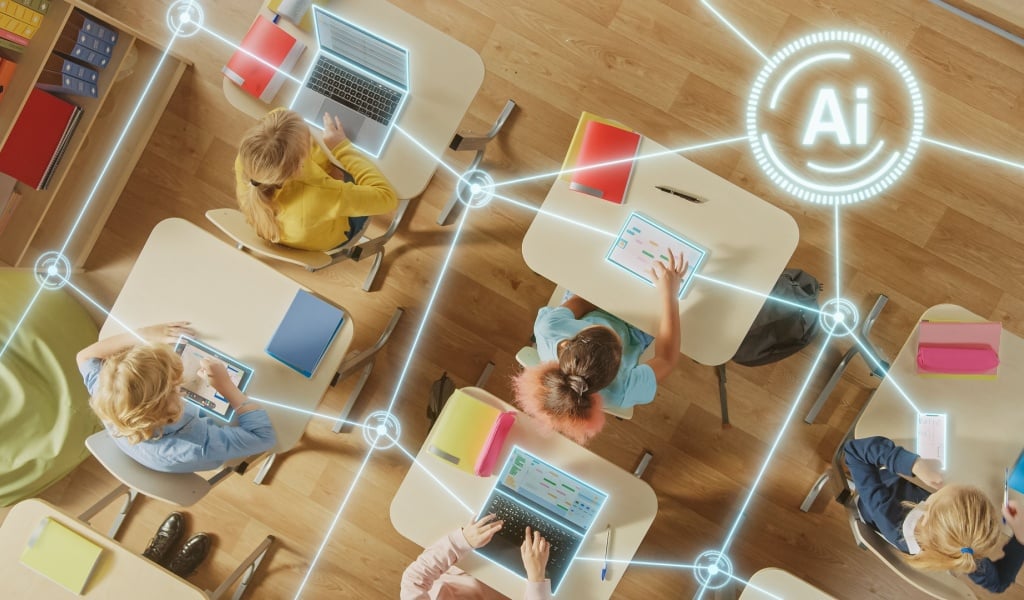
Imagine it’s 2030, and students are entering their classrooms with laptops humming softly beside their notebooks. Digital assistants—powered by artificial intelligence —provide reminders, clarify concepts, summarize chapters… and occasionally do the homework for them.
That’s a world many believed we were heading toward a few years ago. Today, however, many teachers, researchers, and tech skeptics aren’t cheering for the rise of AI in schools. Instead, they’re raising concerns. In fact, many experts now say the disadvantages of AI in schools might outweigh its advantages, at least the way we’re using it right now.
Let’s step into the classroom of the future and discover what all the fuss is about.
The Benefits of AI in Education
The rise of AI in schools didn’t happen by magic; it happened because the technology was beneficial. From personalizing learning methods to automating tasks no one really wants to do, AI has arrived with good intentions. Here’s what scholars and schools have observed about the pros:
- Immediate feedback: Want to know if an essay requires stronger arguments? AI can give immediate guidance. Need grammar checking? Done. These tools help students reflect on their own work.
- Personalized support: Adaptive AI systems can tailor lessons to each student’s performance, providing gentle boosts when learners struggle and additional challenges when they succeed. This type of personalization was once a dream; now it’s part of daily edtech tools.
- Inclusivity and accessibility: For students with diverse learning needs, multimodal AI tools help bridge gaps through text-to-speech, visual aids, translations, and other services.
- Teacher relief: Teachers spend substantial time on grading, planning, drafting communications to parents, or creating rubrics. AI can automate many of these tasks, freeing up time for guidance and creativity.
On the surface, it appears to be a win-win: technology that helps teachers and students. These advantages have driven rapid adoption, with many schools now incorporating AI into learning more than ever before.
However, here’s where the story becomes spicy.
Why Are Experts Concerned?
Not everything AI touches turns to gold. Professionals caution that the current use of AI may weaken the very essence of schooling. So, let’s discover the cons of AI in schools.
Cognitive Offloading Loop
The fact that it encourages students to offload thinking is one of the main criticisms leveled at classroom AI. According to a major global study reported by NPR and the Brookings Institution, students’ critical thinking and deep learning may suffer as they increasingly rely on AI to provide answers. This is known as the “cognitive off-loading loop,” in which students let AI do the thinking.
When this becomes the norm, students no longer learn how to assess arguments, comprehend different points of view, or even distinguish truth from fiction, according to Rebecca Winthrop, a senior scholar at Brookings. These core skills are meant to be developed in school, but they’re put at risk when we allow algorithms take over.
AI can find answers fast, perhaps too fast. Many educators express concern that AI has weakened students’ ability to think critically and creatively, and conduct research. Students may rely on AI summaries rather than engaging deeply with texts, or use AI to solve math problems without understanding the underlying reasoning. It’s similar to always using a calculator — useful, but risky when it replaces skill-building.
Strained Human Relations
School isn’t just about knowledge; it’s also about connections. Many students reported that AI use has strained their relationships with teachers, and educators reported reduced peer engagement, according to a report cited by “Education Week.”
Learning together is a distinctive human capacity that involves conversation, idea exchange, and correction by a teacher who understands context and emotion. AI, no matter how advanced, cannot replace emotional intelligence or mentorship. In schools, these strained connections can gently weaken a sense of belonging and trust.
Gaps in Equity
Another problem is who benefits the most from AI. Advanced, high-quality AI tools are frequently expensive. Wealthier schools can afford more robust systems, whereas schools in under-resourced regions rely on free or less reliable versions. This unequal access risks widening the digital divide instead of closing it.
Misuse and Academic Integrity Problems
When AI can create an essay in seconds, what counts as cheating?
Schools are scrambling to describe policies. Teachers struggle to differentiate between helpful assistance and direct replacement. Without clear standards, academic integrity becomes more difficult to uphold, and learning may suffer.
Privacy, Safety, and Ethical Concerns
AI tools rely on the collection of student data. Grades, writing samples, quiz results, and even learning pace can be stored and evaluated.
However, this raises serious privacy and security concerns, including the risk of data breaches and the invasive recording of student behavior. If poorly managed, AI systems could collect more information than parents or students realize, raising ethical questions on consent and safety.
Students’ Opinion
Students have mixed opinions.
Some students value AI’s convenience for learning and for generating ideas. However, several studies also reveal that many students believe AI makes learning seem too simple or less meaningful. Because AI is so accessible, some continue to use it even when they know that it hinders their ability to improve their own skills.
Therefore, even while tools could seem helpful at the time, there’s a deeper concern: are students learning the proper skills, or just learning how to use AI?
What Can Be Done?
Does this mean schools should ban AI? Not necessarily. However, experts admit it cannot be embraced blindly.
Include AI Literacy in the Curriculum
Students and teachers require structured instruction on what AI is, how it works, and how to evaluate its outputs. Understanding when to question AI is just as important as knowing how to use it.
Create Clear Policies
Schools require clear frameworks for how AI fits into assessment, creativity, teamwork, and academic honesty. Ambiguity invites misuse.
Concentrate on High-Quality Human Skills
Education isn’t just about answers; it’s about critical thinking. Schools need to focus more on teamwork, creativity, ethical reasoning, and discussion-based learning, areas where AI could support rather than replace human development.
Provide Teachers with Better Training
Many teachers are using AI without formal training. Professional development that emphasizes the responsible, ethical, and effective integration of AI is important.
Conclusion
AI is already woven into many classrooms, and it’s unlikely to disappear. However, experts warn that without thoughtful integration and clear rules, the downsides of AI in schools could outweigh the benefits.
The true challenge lies in how we use AI and in whether we protect the fundamental purpose of education: to create intelligent, competent, and independent human beings.