
About 378 trillion kilometers away from Earth, scientists have made an exciting breakthrough in astronomy. The discovery of Gliese 12b, an exoplanet almost the size of Earth, located about 40 light-years away, has sparked new hope and interest in the study of distant worlds.
Since the announcement of the first noteworthy discovery on October 6, 1995, our understanding of the universe has grown far beyond our solar system. What is truly amazing is that after 30 long years, this search for another Earth has not been a waste of time, nor has it lost momentum.
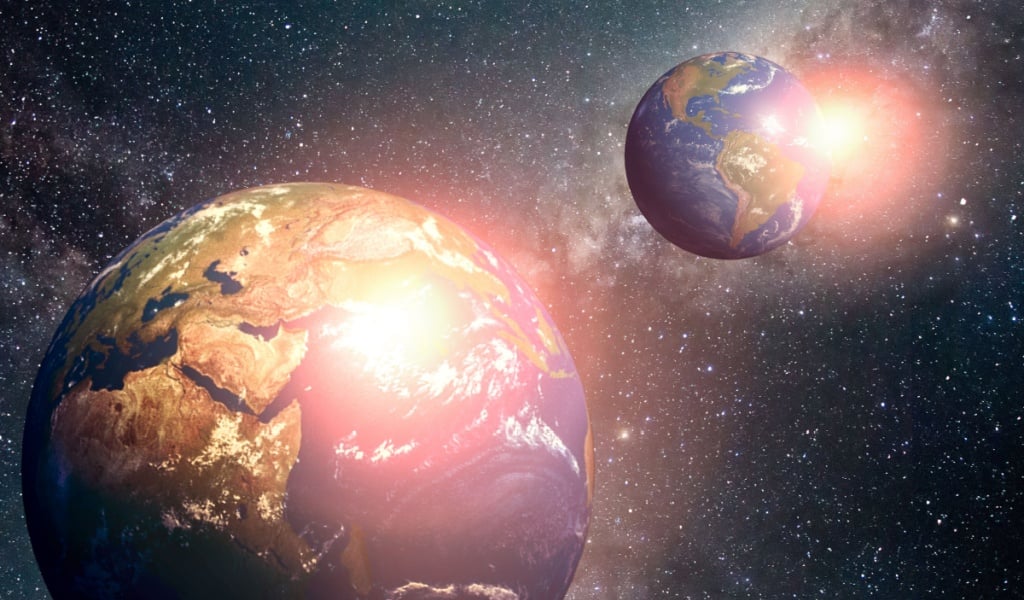
So, what exactly is this “Twin Earth” that scientists are searching for? When astronomers talk about finding a Twin Earth, they mean another planet similar in size and mass to Earth, orbiting a sun-like star at just the right distance for liquid water to exist. Ideally, it would also have an atmosphere that could support life and show signs of biological activity.
The hunt for such worlds has been long and sometimes frustrating. In this article, we will look at the three-decade journey of this incredible search, what scientists have discovered so far, and what they have learned about our universe.
From a Theoretical Idea to Real Targets
Until the mid-1990s, the belief in the existence of planets beyond our solar system was mostly theoretical, so while scientists believed they might exist, there was no proof. That changed in 1995, when astronomers discovered a giant planet orbiting a sun-like star. They called it a ‘hot Jupiter’, and it opened the door to an entirely new era of exploration.
This discovery proved that our approaches to detecting new planets worked. It sparked a global effort to find other worlds, especially ones that might resemble Earth.
At first, the planets found were large and very close to their stars simply because those were the easiest to detect with the technology of the time. But the dream was always to find a small, rocky planet in the ideal zone: a place where temperatures allow liquid water to exist- suitable for living beings.
Scientists named this special region the habitable zone, also called the ‘Goldilocks zone’, not too hot and not too cold. Within this zone, a rocky planet could hold water on its surface and possibly support life. That became the main goal: to find small, rocky planets in the habitable zones of calm, stable stars.
How Scientists Search for Twin Earths
Finding another Earth is a huge challenge. Stars are enormous and extremely bright, while planets are diminutive and faint. Searching for one is like trying to spot a firefly flying next to a giant floodlight from thousands of kilometres away.
To make this possible, scientists use several clever methods and high-tech telescopes; some of those have been listed below:
The Transit Method
Astronomers observe a star’s light very closely. If a planet passes in front of it, even slightly, it blocks a tiny portion of the light. This dip in brightness reveals the planet’s size and orbit.
The Radial Velocity Method
When a planet orbits a star, its gravity makes the star wobble ever so slightly. Scientists can measure this movement by studying changes in the star’s light, which helps estimate the planet’s mass.
Direct Imaging
Capturing an actual image of the planet itself is one of the most challenging procedures. Because stars are so bright, their light often hides the planets. But with advanced telescopes and light-blocking tools, astronomers have managed to photograph a few planets directly.
Atmospheric Analysis
When a planet passes in front of its star, some starlight passes through the planet’s atmosphere. By studying that light, scientists can identify the gases present, such as oxygen, methane, or water vapour. If certain gas combinations are found, it could be a significant clue that life might exist there.
What Scientists Have Found So Far
Over the past 30 years, scientists have discovered thousands of exoplanets— planets outside our solar system. Many of them are unlike anything we have ever imagined. Some are enormous gas giants, some are icy worlds, and some even orbit two stars, like something out of Star Wars.
But among all these discoveries, a few stand out as minor, rocky planets that lie in the habitable zones of their stars. These are the ones that most closely resemble Earth.
One of the most fascinating discoveries is the TRAPPIST-1 system, which has seven Earth-sized planets orbiting a small, cool star. Scientists believe that some of these worlds may have liquid water. Another well-known planet is Kepler-452b, often called ‘Earth’s cousin,’ slightly larger than Earth and orbiting a star that’s a little hotter than our Sun.

Why the Search Matters
Why spend so much time, money, and effort looking for another Earth when we already have one? There is a very valid concern that this search only results in wasted resources.
The answer goes far beyond curiosity. Searching for a Twin Earth helps us better understand our own planet. By studying how other worlds form and change, scientists can learn more about Earth’s history, its climate, and even its possible future.
It also brings us closer to answering one of the oldest questions in human history: Are we alone in the universe?
If we ever find another planet with signs of life, it would be one of the most remarkable discoveries ever made. It would show that life is not unique to Earth and can appear wherever the right conditions exist.
Even if we don’t find life right away, the search itself has already made a considerable impact. It has united scientists worldwide, inspired young students, and led to new technologies that benefit many fields, from cameras to satellites to even medicine.
No one knows precisely when we will find a true Earth twin. It could happen in five years, it might take half a century, or we may never get there. But every discovery brings us a step closer to answering that timeless question: Are we really alone?
Conclusion
The 30-year search for a Twin Earth has already transformed science forever. We now know that planets are everywhere, orbiting nearly every star in the night sky. Some are massive, some are tiny, and some may quietly hold oceans and even life.
As technology improves and our curiosity continues to grow, the day we find an actual Twin Earth might not be as far away as we think. If we actually do, scientists might even begin exploring the idea of traveling to another planet for summer vacations.