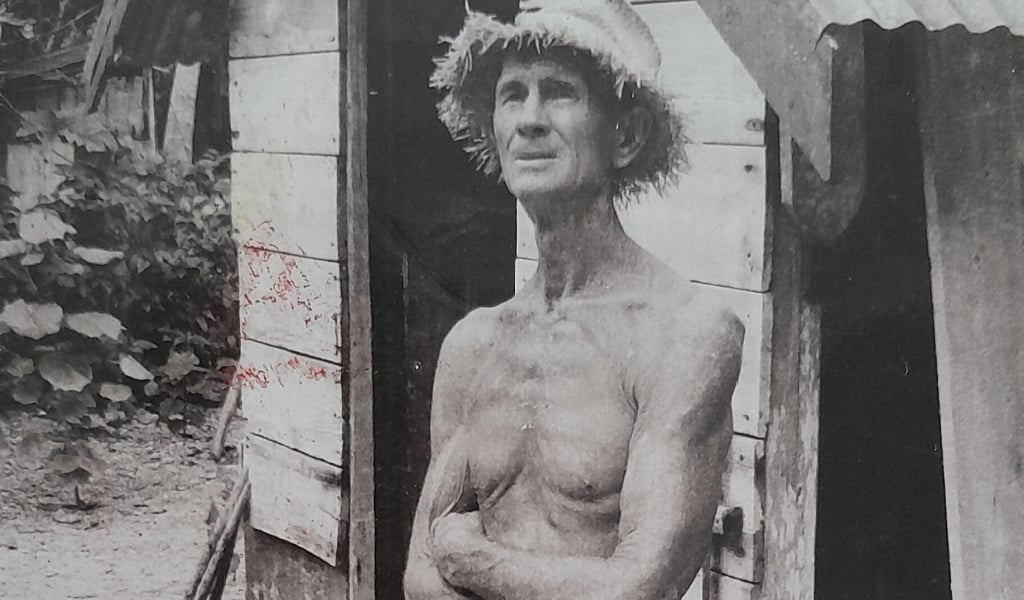
Imagine waking up every morning to the beautiful ocean, coconut trees, sandy beaches, birds singing, and maybe two cats who’re your only housemates. Now imagine picking that life. That’s just what Tom Neale did. For nearly 16 years, he lived alone on the island of Suwarrow (also spelled Suvarov) in the Cook Islands.
Why would somebody choose this kind of seclusion? And how did he survive physically and mentally? Let’s explore his journey and find out the reasons behind his decision.

The Call to Liberty & Seclusion
Tom Neale had toured the Pacific, worked in island villages, and gotten a feel for life outside big towns. He was running toward something. In his own words, he “chose to live in the Pacific Islands because life there moves at the sort of pace which you feel God must have had in mind originally.”
There was a charm in this simplicity: growing his own garden, catching fish, repairing shelters, building things by hand, and selecting his daily tasks based on his own preferences (not someone else’s schedule). He liked being the leader of his world, with minimal external influence.
The idea took root early after hearing tales of Suwarrow from Robert “Dean” Frisbie, who said, for example, “No man has really lived until he has lived there.” Neale was captivated and decided this was the place to test his courage.
Life on the Island on His Own Terms
Suwarrow was abandoned when Neale first arrived onshore in the early 1950s. Other than some water tanks, roaming chickens, and wild pigs, the only standing structures were a few abandoned huts built by coast watchers during the war.
Along with his two cats, he brought food, tools, and books. He tamed chickens, speared fish and crayfish, planted gardens, constructed fences, rebuilt huts, and harvested coconuts, breadfruit, and pawpaw. Additionally, he looked after the animals, kept them away from his garden, fixed the boat, collected rainwater, and collected eggs.
He didn’t just survive; he created a life that had structure, purpose, and diversity. The challenges were real —storms, backaches, loneliness —but the rewards (for him) outweighed the pains: autonomy, beauty, serenity, and alignment with his own principles.
The Ultimate Return
Unfortunately, the tale isn’t pure bliss. Neale returned to civilization multiple times: once due to injury, once because of discomfort as more people (divers, visitors) began to come to Suwarrow, spoiling the original solitude, in his opinion.
There was also the recognition of death: at one point, he understood he was getting old, and the thought of dying alone on the island wasn’t appealing. However, even that didn’t stop him from going back.
In 1977, after being diagnosed with stomach cancer, he ultimately left Suwarrow for the last time.
What About Loneliness?
Didn’t Neale feel lonely all by himself on a deserted island? It’s almost what everybody wonders: can you live that long, all alone, without being torn apart by loneliness?
Neale frequently said he was not lonely. He admitted that he sometimes wished someone were with him, not because he wanted company, but because the island’s beauty felt too perfect to keep to himself.
He differentiated between being in isolation and feeling lonely.
Neal didn’t see himself as a hermit. He didn’t dislike being around people; he just preferred to live in a way that suited him—doing what he liked, when he wanted, and being free of debt, responsibility, or unnecessary noise.
Indeed, there were terrifying situations—storms, wild pigs, disease, long stretches without contact — yet even then, Neale seemed more energized by the tasks than weakened by fear.
Lessons to Learn
Why did Neale isolate himself, voluntarily, for these long years?
- Love for seclusion: not as an escape but as a way to see, think, work, and feel without continuous social interference.
- Desire for freedom: to live by one’s own terms, to be self-reliant, to be connected with nature.
- Challenges and determination: building, gardening, mending, creating rhythms of survival and thriving.
- Aesthetic and spiritual dimensions: he considered Suwarrow as one of the most gorgeous places on earth, a heaven to be shared more with the self than with crowds.
A Journey to Remember
Neale’s life depicts that isolation doesn’t always mean misery. For some people, the absence of people is replaced by other elements, such as nature, animals, the sea, work, and daily routines. It also shows that inner satisfaction might depend more on core values than on social interactions.
Ultimately, Tom Neale chose isolation as he preferred a different type of life—slow, natural, wild in its rhythms, and simple. For 16 years, he lived according to his own plan on Suwarrow, and the story still whispers: perhaps to live fully, we don’t always need crowds. Sometimes, we only need our soul and courage to stand alone.