
Imagine seeing a piece of another planet up for sale at an auction house in New York. Not a science-fiction prop or a movie set piece, but a real portion of Mars, the fourth planet from the Sun and our very own neighbor. This happened in July 2025, when the largest piece of Mars ever discovered on Earth was put up for sale at Sotheby’s and sold to an anonymous buyer for millions of dollars.
Let’s take a closer look at this bizarre, mesmerizing, and slightly surreal moment where space rock, scientific marvel, and money collided.
From Planet Mars to the Sahara Desert
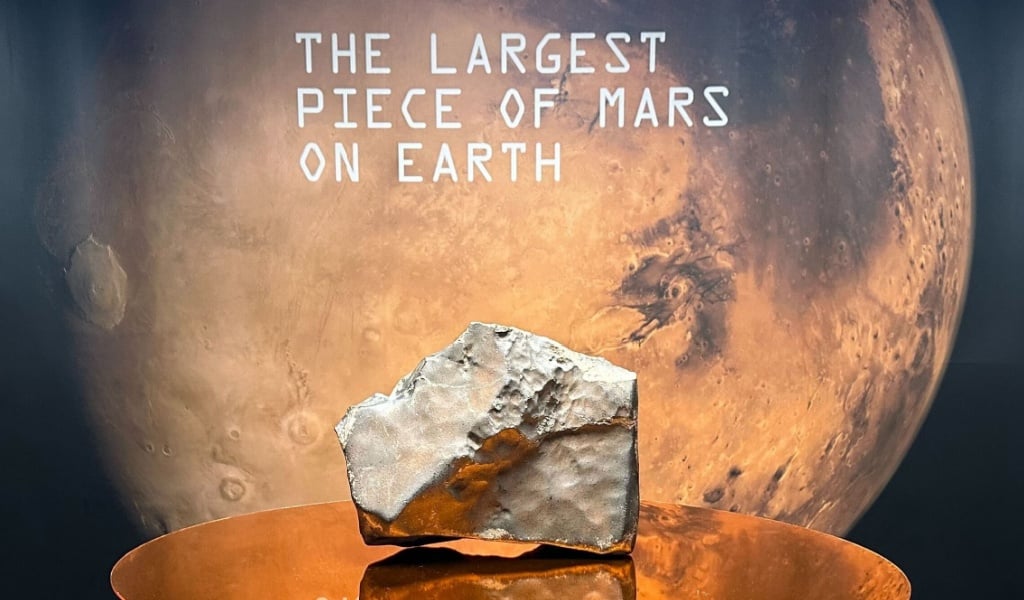
The rock has a name that’s equally official and amazing: Northwest Africa 16788, frequently shortened to “NWA 16788”. However, for some people, such as scientists, space enthusiasts, or collectors, it’s simply known as the largest Martian meteorite ever found on Earth.
Here’s the basic storyline: millions of years ago, a huge asteroid impact on Mars threw debris off the Red Planet’s surface and into space. One piece of that debris flew throughout the solar system for an unknown amount of time before it finally slammed into Earth’s atmosphere, became a meteorite, and landed in the Sahara Desert.
In November 2023, a meteorite hunter searching the dunes of the remote Agadez Region of Niger discovered this strange rock, buried in the sand. Reddish-brown, heavy, and unlike most ordinary stones, it looked fascinating. Tests eventually proved that it was from Mars.
It weighs around 54 pounds (24.67 kg) and is about 70% larger than any other known Martian meteorite found on Earth. This single piece of planet Mars sat in our museums (and, currently, in a private collection). Additionally, it makes up nearly 7% of all Martian material ever found on Earth!
A Meteorite with a Value
If you believe meteorites are rare, then Martian meteorites are extremely rare. Out of more than 77,000 recorded meteorites ever discovered on Earth, only around 400 are confirmed to be from Mars. Most are tiny, weighing just a few grams. So, imagine a specimen weighing over 50 pounds!
Sotheby’s, one of the world’s most renowned auction houses, decided to include this space phenomenon in its Geek Week 2025 natural history sale. That alone indicates that this wasn’t going to be some dusty, forgotten relic in a back corner somewhere.
Before the auction, Sotheby’s estimated it might sell between $2 million and $4 million, an absurd amount for a rock; however, perhaps not when that rock came from another world! The auction began with advance offers between $1.9 million and $2 million, then built steam from there.
The winning bid was $4.3 million when the hammer finally dropped, and the total was about $5.3 million, including fees and the buyer’s premium. That makes NWA 16788 the most valuable meteorite that has ever been sold at auction.

NWA 16788, Science, and a Bit of Controversy
Beyond the big price tags and headlines, NWA 16788 has true scientific value. Meteorites like this are basically time capsules (chunks of planetary material that carry information about conditions on Mars). Studying them helps scientists learn about Martian geology and even the planet’s history with water and volcanism.
However, the auction wasn’t all high fives and joy.
Once news of the sale spread, particularly that the rock was now possibly in a private collection, it sparked debate. Scientists voiced concern that such a significant Martian specimen could become inaccessible to researchers and the public. Many argued that keeping NWA 16788 in a private vault could limit its scientific study and educational value, fueling debate over whether rare extraterrestrial artifacts should remain available to the public.
How the meteorite left the Sahara Desert and entered the global auction raised questions in Niger. Officials expressed concern about the legality of the export, specifically whether the required export permits were obtained. Some also questioned if local communities and the original finder were properly acknowledged or compensated, raising issues about fair benefit-sharing and ethical acquisition.
It serves as a reminder that even when something comes from the depths of space, human problems like ownership, ethics, and access still matter.
A Part of Mars, Now Sold
In the end, NWA 16788 is not just another rock you find in a museum display box; it’s one of the few tangible links we have to another planet. Now, it carries a price tag that reflects both its rarity and our fascination with space exploration.
Whether it ends up under the spotlight at a museum or hidden away in a private collector’s office, this piece of Martian crust has already changed hands on Earth for millions of dollars and seized imaginations around the world. It’s a strange and exciting example of how our reach (and curiosity) go well beyond our home planet.
And who knows — perhaps the next piece of Mars will appear in a driveway, in a glacier, or in someone’s home garden, since stranger things have happened.